
EU CLOs: A Look at Recent Reset Pricing
EU CLOs: A Look at Recent Reset Pricing
Featured Reseach
EU CLOs: A Look at Recent Reset Pricing
US BSL CLOs: Thoughts on Recent Reset Pricing
Across the 171 EU CLO deals that have been redeemed, the overall average IRR was 11.8%. The top quartile of deals achieved IRRs of at least 13.5%, while the bottom quartile recorded IRRs below 7.3%. Notably, the top 25% of deals within each vintage delivered minimum IRRs in the low teens, except for the 2017 and 2019 vintages, broadly in line with the returns typically marketed for CLO equity at primary issuance.
A sample of 538 fully repaid EU CLO BB tranches with disclosed issue prices or DMs is included in this study. Overall, their performance has been very impressive, with an average realised IRR of 10.1%.
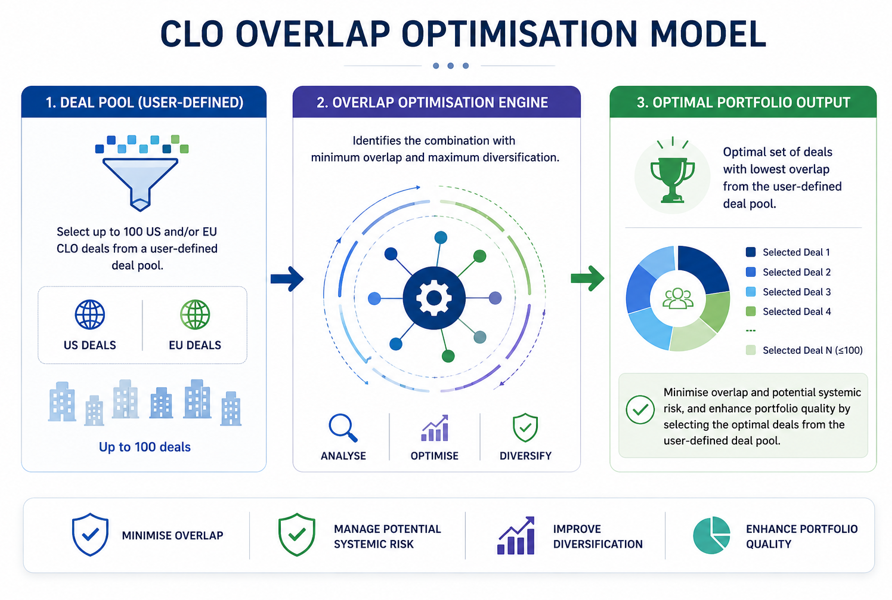
Please find the download link in this article for the overlap optimisation model. The model allows users to select up to 100 US and/or EU CLO deals from a user-defined pool of deals and identifies the optimal combination to minimise overlap.
The 2018 vintage has experienced the highest impairment rate so far, with approximately 19% of single-B rated tranches having become impaired. Unfortunately, this rate is expected to rise further...
A sample of 351 fully repaid single-B tranches is included in this study. Overall, their performance has been very impressive, with an average realised IRR exceeding that of equity tranches. In addition, single-B tranches generally carry lower risk than equity, given their second-loss position in the capital structure.
This model tracks reported WAS and WARF trends across 129 US BSL CLO managers, with monthly data dating back to April 2013. Select up to five manager-vintage combinations from the dropdown menus, and the chart will instantly compare their WAS and/or WARF levels.
A sample of 333 deals from the 1Q 2024 to 4Q 2024 vintages is used, excluding static deals and those with a collateral factor below 0.75. Each deal’s underlying collateral weighted average spread (WAS) is adjusted to reflect its weighted average price (WAP) as of June 5, 2026.
This study is based on a sample of 1,600 U.S. BSL CLO deals. Static deals are excluded from the analysis.
In the US BSL CLO market, 12 and 27 managers offer average pairwise overlap levels of below 50% across their optimal five-deal and three-deal combinations, respectively. The table below presents the average pairwise overlap for these optimal combinations by manager.
Is it possible to achieve low overlap among three deals from the same EU CLO manager? In the EU CLO market, 18 managers offer an average pairwise overlap of less than 50% across their optimal three deals.
AAA/AA investors are always thinking about systemic risks, and one way to reduce this risk is to minimise overlap exposure within their portfolios. The beauty of this model is that users can choose from a pool of CLO deals managed by managers they favour and optimise the portfolio for the lowest possible overlap risk based on the target number of positions they are looking to hold. Please find the download link below for the overlap optimisation model, which allows users to select from a pool of US BSL CLO deals to be added to an existing portfolio, with the model identifying the optimal outcome from an overlap perspective.
Please find the download link below for the overlap optimisation model, which allows users to select from a pool of EU CLO deals to be added to an existing portfolio, with the model identifying the optimal outcome from an overlap perspective.
Please find below the download link for the interactive CLO manager collateral AUM ranking tables.